
Death On The Covid-19 Quarantine Ward, El Paso 2020-08-25
By Karen Strickholm
August 2020 – “Contracted Covid-19. Bad. Sent to isolation COVID ward in El Paso (Texas) hospital, during that city’s peak pandemic moment – you may remember it in the national news. Spent one month in COVID acute care on 15 liters oxygen, mobile tractor trailer morgues out back, FEMA tents crammed into overflow spaces, Code Blue called near daily all around me, on bi-pap to breath. It’s touch and go. Too weak to stand, too weak to walk. In-dwelling foley installed, remaining in place for next three years.”
Aug 25, 2020 KINDRED HOSPITAL EL PASO
Out Of The Ward, Onward
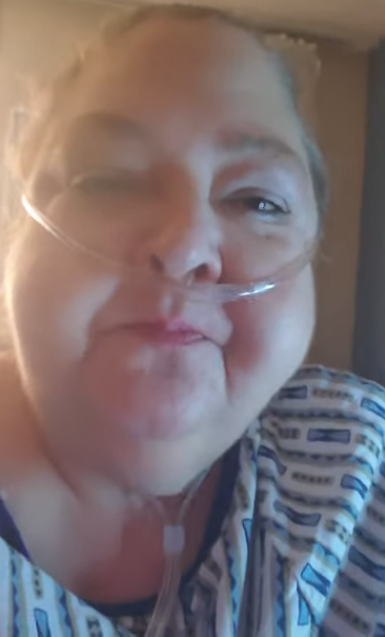
Karen Strickholm, KINDRED HOSPITAL EL PASO
Out Of The Ward, Onward
so what’s been going on is i almost died of covid
i got really sick and from the last time i updated everybody i just uh i don’t even know where i left, things off
i had um pneumonia and septic shock and that was about 12 weeks ago it put me in the hospital and then um was recovering from that pretty well actually and was in a specialty hospital for my wounds which were being treated aggressively and really responding, and while i was there i got coded and i was transferred into quarantine at the hospital in el paso and from there um i went downhill very fast and uh almost died
i was on 12 liters of oxygen and pretty critical i’m making a video i’ll talk to you later and um and that’s what happened
so while i was in there it was very intense you could hear the other patients but you knew about them but you never see them and you never meet them
so i hear about them from the nurses so for example there was one man who was 91 and he could only talk to his daughters on facetime on a on a you know tablet that the nurse had to hold for him and um i i was you know there when he coded next door to me and heard him die
i mean basically heard him code not die but about two weeks in and there was another woman who was about my age she was struggling pretty hard and they finally decided to put her on a ventilator and as they were moving her to the icu she coded and i heard her die
also it was really intense and i myself was fairly critical luckily at the time when they decided ventilators were not the best thing um so i didn’t have to do that but i was on 12 liters of oxygen which is crazy
i had pulmonary edema and this is all following having you know septic shock and pneumonia for christ’s sake
so the dying part is getting really old i’m now on all kinds of drip antibiotics you can see that that’s the drip i’m in a step down hospital so it is a hospital it’s for acute care you can see the wall with all this stuff on it and uh it’s my bed and my strength is beyond gone
I today had physical therapy and i could stand for um 60 seconds was my max so it’s all a pill from there strength wise
i’m glad i have the opportunity to update everybody and i’m sick of this almost dying it’s getting so old but i made it through and and the thing that a lot of people say to me now is congratulations on making it because you know what a lot of people don’t and this did not need to be i did not need to get covid
nobody did you know this is just massive public health mismanagement this is what this is
so everybody stay safe out there wear your masks please for yourself and for others and know that this is a serious life-threatening virus it’s not just your lungs even though it you know definitely impacts the lungs
it affects the whole body and um recovery can be long and difficult um i don’t know what mine’s gonna look like but uh onward right
you just have no friggin idea how many medical expenses there are when you’re really sick it’s just it’s friggin endless man all right everybody take care i will talk to you soon
bye bye
Next Episode:
Made It Through Long Covid-19! A Bed In Roswell 2020-10-18
Previously:
COVID-19 In El Paso The Plague 08/02/20
About this series…
Karen Strickholm had a hidden brain tumor on her pituitary gland. The tumor she didn’t know she had until she was about 50, wound up taking her health and all she had built in life. Her tumor, diagnosed in 2008, caused a tsunami of symptoms and eventually forced her into long-term care in a nursing home and a series of hospitals.This is America, the only developed nation that does not have universal healthcare, and the only developed nation where medical debt can force you into bankruptcy.
Karen became one of the financial statistics due to her medical debt, and the fact that she couldn’t get Medicare unless she was literally penniless.
What made Karen different from many other people was her relentless optimism and belief that she was going to get better, would walk out of the nursing home to build a new life. She was smart, a good writer and she left behind a number of digital artifacts, which have been collected into this series. Karen relates, in her own words, her journey through the American healthcare system and the reality living penniless in a nursing home long term.
Karen Strickholm died 6 April 2026 in a hospital in Albuquerque, New Mexico, of sepsis and pneumonia. She was 67.
This multimedia documentary series is her story.
Medical bankruptcy
• Approximately 66.5% of non-business personal bankruptcies in the U.S. were attributed to medical reasons in 2019.
• 1 in 10 U.S. adults (10.5 million) have experienced medical bankruptcy since 2001.
• 78% of bankrupt individuals in 2022 cited medical expenses as their primary cause.
• Medical bankruptcy rates increased by 21% from 2010 to 2020, even as overall bankruptcy rates declined
• The average interest rate on medical debt from bankruptcies is 21% (2022)
https://worldmetrics.org/medical-bankruptcies-statistics/
Nursing home stats
• On any given day, more than 1.3 million individuals receive care in a nursing home or skilled nursing facility, and a total of more than 4 million receive care each year.
• 6 out of 10 residents (64%) are short-stay patients who remain in a skilled nursing facility for an average of 25 days.
• Nearly four out of 10 residents (36%) are long-stay residents. These individuals often have multiple health conditions. Their average age is 76.
• Nursing homes employ about 1.5 million people.
• Nearly 90% are women, and 60% are people of color.
• One out of every five nursing home workers is an immigrant.
• There are around 15,000 nursing homes in the United States.
• The average size of a nursing home is 109 beds.
• Medicaid covers the cost of care for nearly two out of every three residents (63%).
https://www.ahcancal.org/Data-and-Research/facts/Pages/default.aspx