One significant pest, like the New World screwworm, takes hold in this “crop” and the whole shootin’ match is at risk.
The flesh-eating New World screwworm only matters if you eat beef and don’t want to pay high prices for the privilege. Or if you’re cattle rancher in North America. Or a cow in North America.
But it could, can, and does eat the flesh of cattle.
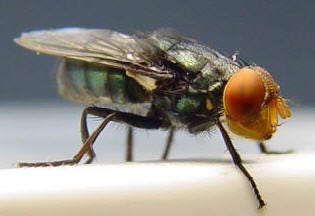
Screwworm fly. The Mexican-American Commission for the Eradication of the Screwworm – The Mexican-American Commission for the Eradication of the Screwworm. Public Domain
As many MAGA created crises have a tendency of doing (see COVID-19 response circa 2020, Iran war, painting National Mall reflecting pool blue, but getting green, etc.), the screwworm crisis is rapidly worsening and threatening to spiral out of control. As with these other MAGA situations, the screwworm crisis was totally avoidable but ideology turned it into a real emergency.
The bigger problem is New World screwworm doesn’t just infect cattle. Or humans.
As the 16 June 2026 report in The Guardian notes, so far (that we know of) “The infected animals include cattle, goats, sheep and one dog.”
The New World screwworm isn’t a disaster waiting to happen. It’s a preventable disaster that is already happening.
“For nearly six decades, the parasite was rarely seen in the US after being largely eradicated in the 1970s. However, its re-emergence and rapid spread have raised concerns that the parasite is making a comeback at a time when beef prices are at record highs.”
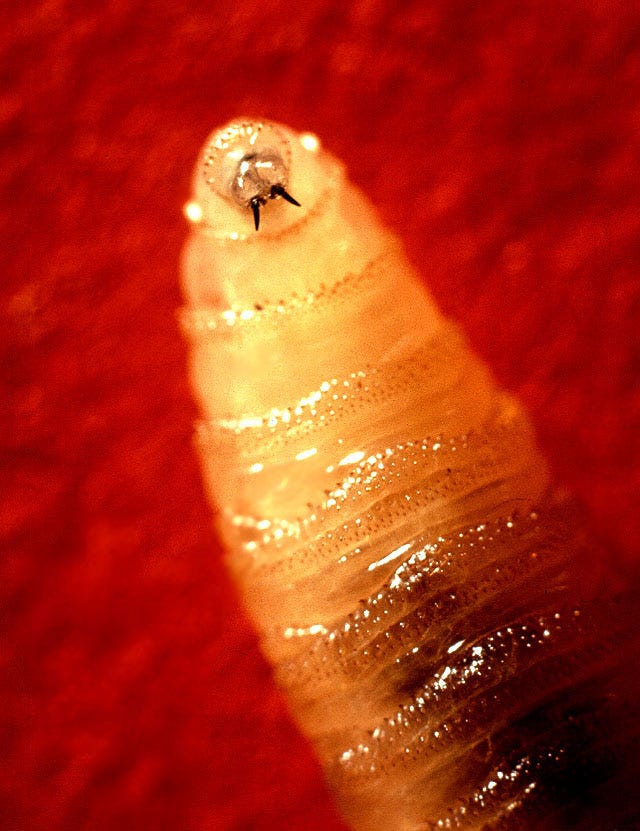
Screwworm larva. Tusklike mandibles protruding from the screwworm larva’s mouth rasp the flesh of living warm-blooded animals. A wound may contain hundreds of such larvae. Public Domain
The Guardian story comes off more as a story about public relations damage control, and doesn’t at all address how this situation came about after the problem was under control for 70 years.
Of course, the fact that the problem getting out of control just happened to happen at the same time the second MAGA administration took control, isn’t at all addressed in the 16 June news story.
The story parrots a statement from the credibility-impaired USDA:
“It added that despite the outbreak, the US food supply remains safe, as the screwworm does not infest meat, fruits, vegetables or other fruit products.”
No, the food supply does not remain safe.
The entire beef industry in North America is threatened. The USDA statement is trying to conflate cattle on the hoof with the meat shrink-wrapped in the butcher section of your grocery store. It’s like saying just because a massive drought or plant disease has destroyed 90% of the American wheat crop in the fields, everything is ok because there’s still bread on the grocery store shelves.
Don’t think for a minute that the screwworm isn’t serious business for the cattle industry or that it only matters in Texas or that it doesn’t affect YOU.
The most recent screwworm infestation has been in progress since at least 2023. It became an urgent issue in November 2024 when the pest reached southern Mexico.
The 23 July 2025 analysis story from the weekly, The Western Producer, the leading agricultural publication for Western Canadian farmers and ranchers, details how the pest was a first detected in Panama in 2023, and it was seen slowly moving north.
When the screwworm reached southern Mexico, that prompted a move to close the border to Mexican cattle in November 24, a prudent move under tri-national pest controls.
Then the U.S. border opened to Mexican cattle in February 2025.
That didn’t last long.
On May 11, the U.S. again closed the border to Mexican cattle.
“Mexico reported screwworms about 370 miles south of the U.S. border in Ixhuatlan de Madero, Veracruz, on Tuesday, the USDA said in a statement late on Wednesday. The agency ordered the closure of livestock trade through southern ports of entry effective immediately,” the trade publication AG Canada reported.
“Closing the border isn’t just justified, it’s essential,” said Bill Bullard, CEO of U.S. cattle producers’ group R-CALF USA, in Reuters report in AG Canada.
I’ll pause here to ask, what happened between November 2024 and February 2025, when officials attempted to reopen the border to Mexican cattle? An election, perhaps? In January 2025, inauguration day to be exact, an extra-governmental entity called DOGE was formed and was rampaging through government agencies like the USDA as this crisis was unfolding.
MAGA politicians, especially those in Texas are responding to the spreading screwworm infestations with a mixture of alarm for the industry and disdain for the reactions of America’s two largest trading partners.
On 6 June 2026, Canada restricted imports of American livestock in reaction infestations found in Texas.
The day before, 5 June 2026, Texas Gov. Gregg Abbott called the fact that screwworms had been found in Texas an “imminent threat.” He declared a statewide disaster. Federal and state authorities set up 12-mile quarantine zones around both areas where screwworm infected calves were found — within five miles of each other, in Zavala County — prohibiting movement of any animals without inspection.
Despite this, a spokesperson for the Texas governor told USA Today that “Canada’s broad restriction on Texas livestock is an overreaction that is more political than science-based.”
As usual, MAGA elected officials went on social media and blamed the Biden Administration, despite the fact this infestation went out of control a year and half after Biden left office. Secretary of Agriculture Brooke Rollins took to social media on to blaming the Biden administration’s “WEAK foreign policy agenda and FAILED immigration policies” for the parasite’s reemergence.
Canada is probably acting out of an abundance of caution because the currently known range of the New World screwworm does not extend above the lower part of the midwest.
However, climate change has been making summers warmer for longer and it is possible the pest could make it on animals into Canada during the warmer months, though it probably would not survive the winter.
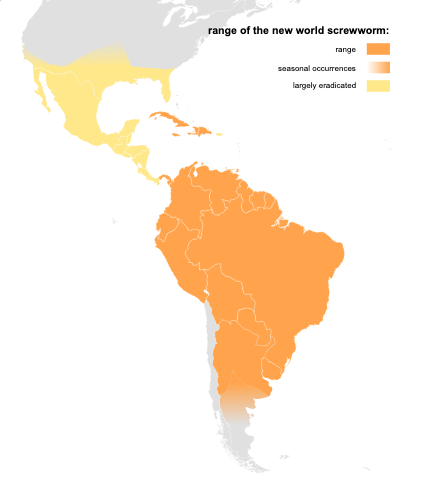
The New World Screwworm is endemic to much of South America and parts of the Caribbean. The gold colored area show “largely eradicated,” but that may soon no longer be true.
Range of the New World screwworm 2025. Creative Commons
“Because of the mass immigration, a disease that had been — we’ve been rid of in North America made its way up through South America, you know, as these migrants brought some of their cattle with them,” Bessent lied on Fox.
“So part of the problem is we’ve had to shut down, to close, to shutter, etc., the border to Mexican beef because of this disease called the screw worm. So we’re not going to let that get into our supply chain. And, again, I don’t want to focus on one product. It’s a very important product. And if we are laser-focused on this product,” Bessent continued to lie.
Reality, however, keeps intruding into MAGA’s screwworm screw up.
The reality is that questions are mounting about the White House’s lackluster response to the crisis due to DOGE’s broad cuts at USAID that took place almost immediately after the MAGA Reich took office in 2025 that ended screwworm monitoring programs in South America that were considered foreign aid.
The screwworm infestation is really just the cherry on the top of the reasons why beef is selling at record prices.
There’s a larger vicious cycle at work that is both environmental and economic.
All cattle and calves on feed in the United States at the start of 2026, totaled 86.2 million head, a 75-year low, down about 300,000 head, or 0.3%, from 86.5 million head in 2025, according to the National Agricultural Statistics Service, USDA, Cattle Inventory report released 30 January, 2026.
The lifecycle of cattle breeding is longer and produces few young compared with pork and chicken. Raising a calf to slaughter weight is relatively more expensive than other types of meat.
According to a 10 February 2026 market analysis by The American Farm Bureau Federation:
“A smaller 2025 calf crop also means there are fewer cattle available to be placed on feed in 2026. The U.S. border to Mexico remains closed to imported livestock including beef cattle to combat the spread of New World screwworm. Approximately 1.2 million-1.5 million head of cattle placed into feedlots for beef production are imported to the U.S. from Mexico when the border is open each year. This supply constraint will keep prices for feeder cattle elevated in 2026 and 2027.”
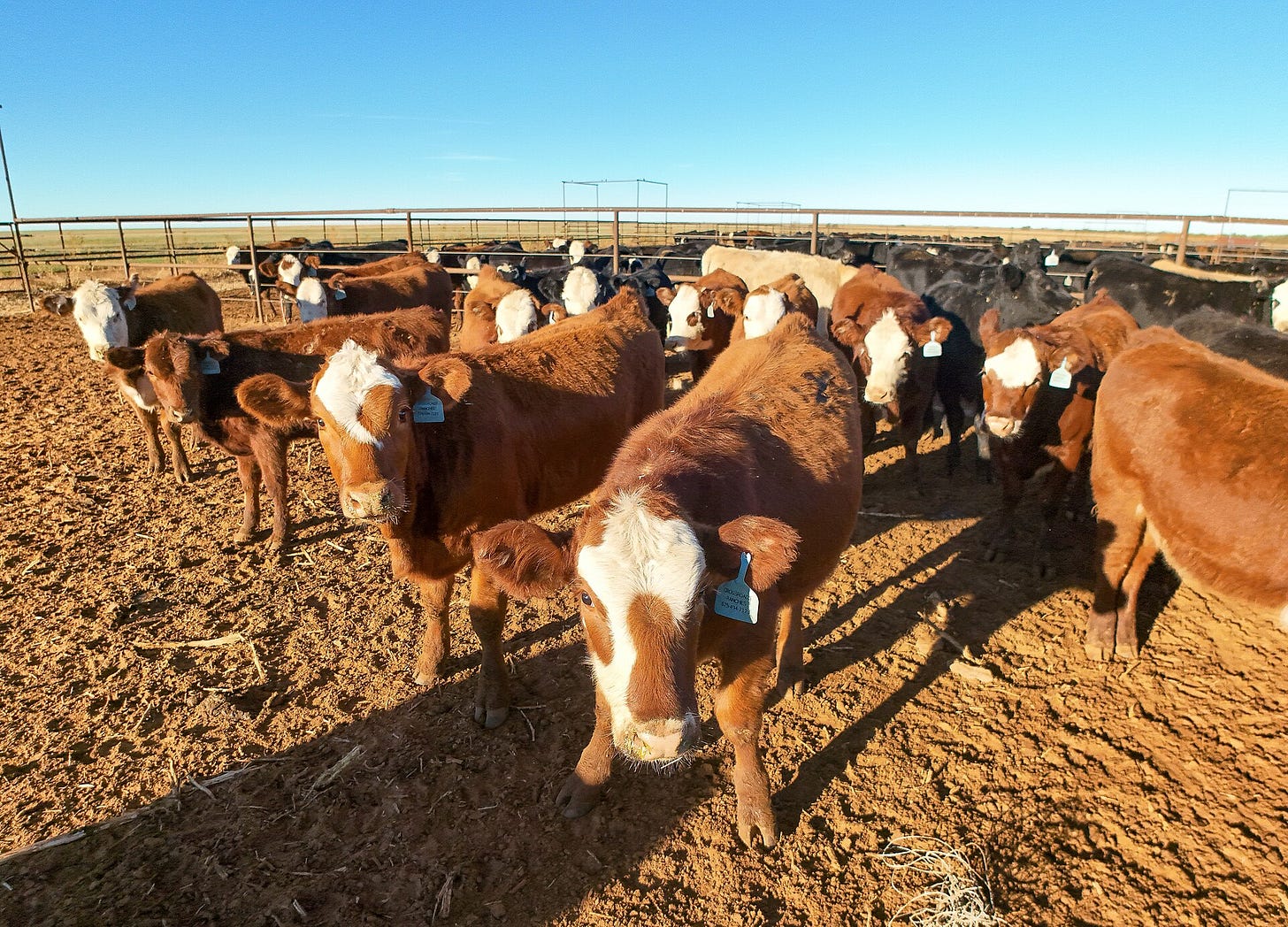
Cattle feedlot in New Mexico, United States. Creative commons
“The continued decline in cattle, though small, means we are now in year 13 of the current cattle cycle and year eight of contraction,” according to the American Farm Bureau Federation report.
Another major factor in the reduction of cattle herd sizes is severe and ongoing drought in many of America’s largest cattle producing regions. Ranchers can’t feed as many cattle due to drought destroying range land and are reducing herd sizes as a result.
Inflation and tariffs are also playing a role in high beef prices. Even a tariff exception for Argentine beef imports is likely to do little to reduce prices.
One other major factor in high beef prices is the fast there are only four major meat distributors in the United States. The four, Tyson, JBS, Cargill and National Bee, process 85% of the nation’s cattle and effectively control prices. The processors have no incentive to lower prices even if the beef supply expands suddenly in the near future, which it won’t.
It takes roughly two years to bring cattle to market, and several more years to rebuild herds, leaving little room for short-term relief. And this is an issue that’s been discussed for at least 16 years.
Despite record setting prices, consumer demand remains high and the reasons for that seem hard to explain.
At least one economist, quoted in an Argentinian agriculture publication, AgroLatam, tried to say consumers were buying high-priced beef because they’re earning more. While this explanation might look good on a graph, it ignores the reality that any increases in wages are essentially being offset by inflation overall and higher prices for other groceries and gasoline.
Another hard-to-swallow explanation is consumers are buying beef because of a dietary trend toward consuming more protein. And then there’s the argument that beef on the shelves now is higher quality, so shoppers are willing to pay more. I’m not sure most shoppers have any real idea of the difference between USDA beef grades. But They do know they’re paying more than they used to.
Yet another purported reason , one that almost makes sense, is that consumers are loyal to beef as their source of protein. They’ll buy beef no matter the cost.
Meanwhile, the failure to contain the screwworm continues to turn the screw.
At the moment this is no evidence that won’t infect pork, poultry, sheep and pets since that’s already happened in Texas. And does anyone realty trust Texas and the MAGA-weakened USDA to stop the spread?
While human screwworm cases are now rare in the United States, it is possible for human screwworm infections to become more widespread.
“Nicaragua’s health ministry has confirmed that 30 people have been infected by the New World screwworm (Cochliomyia hominivorax), a flesh eating parasite that continues its resurgence in the Americas,” BMJ, formerly the British Medical Journal, reported 19 February 2025.
The parasite was eradicated from Central America at great cost in the 1990s but returned to countries throughout the region in 2024, causing the worst outbreak in decades. This has raised serious concerns for the region’s livestock industry but also for public health as the number of confirmed cases in humans grows.
So far Costa Rica has recorded 28 cases and at least two deaths. In Nicaragua, where the health minister says that cases are under-reported, two patients among the 30 recorded cases have required lifesaving hospital treatment. “If those worms hadn’t been removed, they would have destroyed their brain,” said Ricardo Somarriba, director of Nicaragua’s Institute for Agricultural Protection and Health.
President Trump appoints John Bellinger as senior advisor for NWS preparedness. Bellinger is a Texas A&M regent and cattleman.
June 7, 2026
NWS is confirmed in a calf in La Salle County, Texas.
The first case in New Mexico is confirmed. The affected animal is a dog in Lea County, New Mexico, that had recently been in Mexico. This case was initially reported in Andrews County, Texas, and is believed to be an isolated incident.
USDA confirms the second case of NWS in the U.S. The affected animal is a 1-month-old calf in Zavala County, Texas, located approximately 5.6 miles away from the initial case.
Governor Greg Abbott issues a statewide disaster declaration, authorizing all available state resources to combat NWS.
Louisiana tightens restrictions on animals entering the state from screwworm-infected states.
American Consumers Power Through Record Beef Prices
Despite record-breaking beef prices across the U.S., Americans continue purchasing at historic levels. Analysts point to strong wages, protein trends, and premium quality as key drivers.